Real Estate Map Search

Use Real Estate Map Search Tool to Promote “Starbucks Factor” for Home Listings

People love their lattes. We mean, really love their lattes. So much so that those overpriced cups of coffee can actually affect the price of real estate in the surrounding area.

It’s true. Researchers have found that the proximity of a home near a Starbucks actually helps increase the value of that home. And, in a related trend, the same is starting to happen for upscale food stores such as Whole Foods or Trader Joe’s.

What an awesome gift for a real estate broker or agent. You may have some listings for properties that are mediocre, but promote the fact they are near one of these cool specialty establishments, and just like that, you added whipped cream with mocha sprinkles to that listing.

In fact, there is a real estate map search tool you can use to take advantage of the “Starbucks/Whole Foods/Trader Joe’s Factor.”

It’s called SpatialMatch, and it is offered by Home Junction, specialists in developing WordPress real estate websites and creating hyper-local data widgets.

Here’s how it works: You embed the geo-based real estate map search tool widget onto a website. It’s a very simple process, mostly involving adding a few lines of code. But those few lines of code create access to a tremendous database of local businesses, schools, roads, hospitals and other amenities.

That database is also then spatially oriented in map form so it can show the distance relationship of those data points to any property.

As for home listings, the SpatialMatch platform is then integrated with an IDX feed for local MLS listings.

Put all this together, and now you have a real estate map search tool available on your website to attract home buyers.

This works by pulling up property A on the SpatialMatch platform. Then using the business search function to find coffee shops and restaurants within a certain radius, say, five miles.

Does a Starbucks pop up? A Whole Foods? A Trader Joe’s. If so, bingo, you just created more value for a property without adding one kitchen cabinet or a new gallon of paint.

There’s more. Say there isn’t a Starbucks nearby. Maybe it is 10 miles away. So what, run a search and point it out on the map. On a map, objects are closer than they appear. That location will still have appeal.

Better yet. Perhaps you don’t have the Starbucks or the Whole Foods or the Trader Joe’s. Find other gems using the SpatialMatch tool.

Perhaps there is a coffee shop that locals voted “best cup of java in town.”

Or maybe there is a five-star Italian restaurant nearby. Maybe a yoga studio with an instructor who once worked stretched with movies stars.

The possibilities are endless. Do a little digging on Trip Advisor or Yelp. Create your own version of the “Starbucks Factor”—you don’t necessarily need green-bibbed baristas to make a property attractive.

If you don’t want to add the map platform, you can always just order a raw data feed from Home Junction in the format you prefer. You can still show a list of local businesses and their distances from any address.

This is the age where consumers want more. Mainly, because they have technology at their fingertips that allows them to search for more.

With the SpatialMatch real estate map search tool platform, you will position your website as the first go-to place to find that special go-to coffee shop, restaurant, golf course, etc.

To learn more, check out Home Junction’s raw data page under “Points of Interest” real estate map search tool.

Real Estate City Data

Use Real Estate City Data To Move Up In Search Rankings

Want to know how Google became a gazillion-dollar company that owns the Internet? Want to know how you can use hyper-local real estate data to build up your business just like Google?

Actually, it’s very simple. Here’s how Google did it. Back in the day, when Sergey Brin and Larry Page were doctoral students at Stanford University, they were thinking, “How can we make a better search engine?”
At the time, Yahoo was it. Yahoo was famous for being one of the first websites to be able to categorize the booming number of websites online and give searchers some direction on how to find what they want.
The young Googlers came upon this idea: research papers frequently cite other research papers for authority and credibility. What if we created a search engine that measured how well websites linked to other websites that they thought offered authoritative and credible content?
Simple premise right?
Nothing really ground-breaking about it. This was the practice for research papers for as long as research papers were written.
But Brin and Page were smart enough to be the first to apply this to the web. They developed algorithms that ranked pages and then tracked which ranked page linked to other pages.
The rest is history. (By the way, in one of those stories that make you wince, Google once offered to sell their formula to Yahoo for $1 million. Oops, that turned out to be a $513 billion with a “B” mistake that could actually spell the demise of Yahoo).

Using your own real estate city data to show authority

 In this era of “big” data, massive amounts of data can be transferred quickly and can be displayed easily on websites.
For example, Home Junction is a data provider of hyper-local real estate data – demographics, school information, business information, recent home sales, home prices, weather, cost of living indexes, etc.
For counties and cities all over the country.
As you can imagine, that’s a massive amount of data. “Big” data actually.
But Home Junction is able to place data widgets on local real estate websites so they can display a subset of their data for their particular neighborhoods that the broker or agent is trying to farm.
What this means is that in an instant, a local real estate website can not only be a source of local property listings, but also a valuable “hub” of hyper-local data.
Now in a recent article on Inman entitled, “How to Master The Big 3 Content Marketing Drivers” there is an agent who mentions how he gives valuable content to other websites. This helps out those websites.
In return, he asks for reciprocal links back to his website.
There’s the Google “authority” link we talked about earlier.
That’s Google’s business model – that’s how websites move up the ranks to Page One for search results.
So, with your Home Junction real estate data, you can provide valuable hyper-local facts and information to other local websites.
Take a mommy blogger in the area who writes about shopping for example.
Send her some information about the local Cost of Living Index for the area. How this area compares to the national average for apparel, education, entertainment, food, health care, housing, transportation and utilities.
Get her to link back to your website.
Bingo! Brin and Page now see your site as a valuable resource and will probably and hopefully move you up in their rankings (okay, as you can imagine. It’s a lot more complicated than this. Especially when every Tom, Dick and Zillow wants to move up in the results on search engines.)
But you get the idea.
Real estate data is great for SEO. Go get some. Call Home Junction.
realstir

Realstir Takes an Innovative, Consumer-Focused Approach to Traditional Real Estate Websites

When it comes to those large real estate websites, sometimes it appears as though the model is not fully optimized for the benefit of the consumer or an agent. Here’s why:

Consumers have difficulty getting all the information they need unless they fill out a lead form or call an agent first. Agents get shut out of areas because they are not paying enough.

Realstir is out to change all that. This San Diego based company is taking an entirely new approach to real estate websites and the marketplace. They want to give consumers the friction-free tools they need to look for a home at their own pace and under their own terms.

They also want to give agents a legitimate shot to prove they are the experts in their neighborhoods. Not based on how much they pay, but on how well they contribute to the consumer’s quest for knowledge.

“Consumers are sick and tired of being bombarded by emails and phone calls,” said Marina Tringali, Director of Marketing. “Our mission is to serve the consumers by helping them learn more about a community first.”

To achieve that, Realstir’s search process lets the consumers stay anonymous on their website and their app. Unlike other real estate websites, Realstir allows consumers to look at listings, search hyper-local community information and ask agents questions, without giving up their contact information. Their privacy is protected.

“They are in charge. Their names are not released to the agents until they are ready,” she said.

This enables consumers to learn more about a neighborhood on their own, and not through the filter of somebody trying to sell them something.

Realstir Partners With Home Junction for Real Estate Websites & Data

To help achieve this goal, Realstir has partnered with Home Junction Inc., a national real estate data provider and website developer.

Home Junction supplies the MLS feed directly onto the site. It is continually updated in short bursts of time, so property data is very current. The company is able to supply local data drilled down to particular neighborhoods.

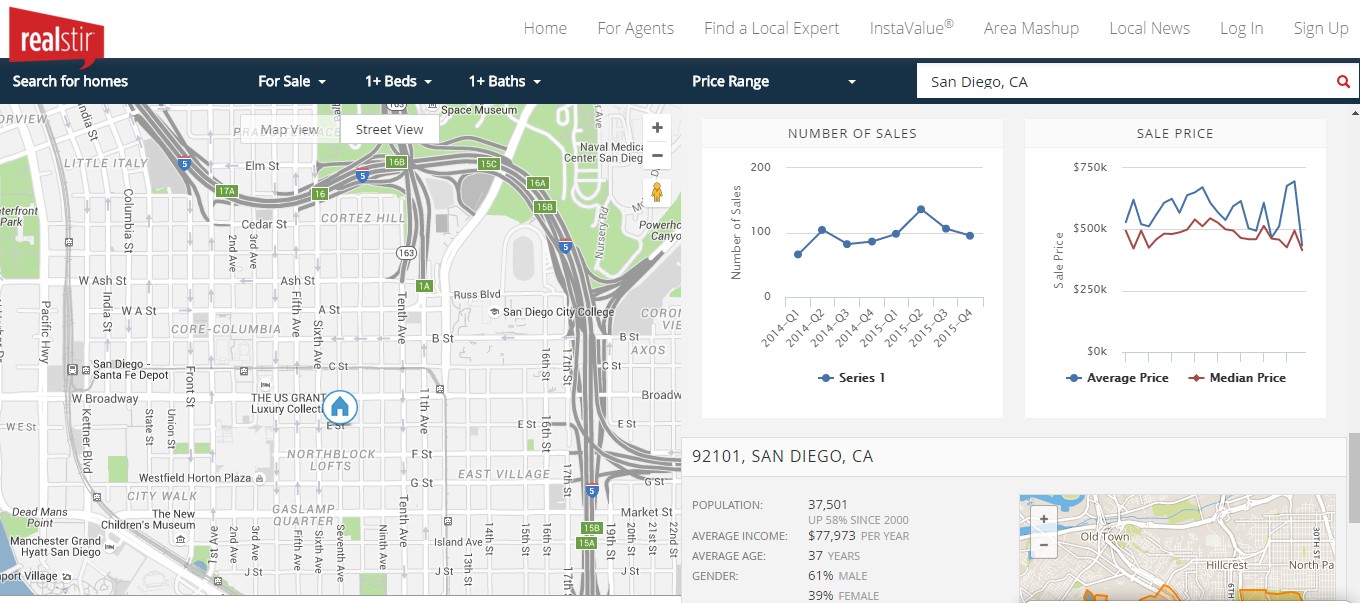
For example, when a consumer visits a listing on Realstir, they can also see charts for the “Number of Sales” in the area for the past few quarters and the “Sales Prices.” That’s incredibly valuable in determining trends.

There is also a chart for local demographics for that area–incomes, education, genders, number of households, households with children, average length of residency, and whether the crime rate is high, average or below average. etc.

On the app, there is detailed school information. Finding out where a child will be attending school can be just as important as the home itself.

Another chart shows “Cost of Living Index”—very important to families. It gives them a sense as to whether costs in this area for clothing, education, healthcare, good, transportation or utilities are above or below average.

In fact, there’s an “Area Mashup” that will show a home buyer how that area compares to other sections around the country. If you are moving from New York, for example, it might be very helpful to know how the new neighborhood measures up. Will there be a significant savings in overall expenditures for my family? Is everything much more expensive? That alone could be a major deciding factor for a buyer.

Realstir even shows data about the weather. Maybe not a big deal, but it would be nice to know how hot or cold it is and how much rain or snow the place gets. A warmer climate sometimes can be a big catalyst to make an immediate offer.

At that point, many home buyers don’t want agents calling or emailing them. They are not ready. They are still on a fact-finding mission.

But if the consumer looks at this data or the listing and has a question, there is a convenient “Chat Now” button right there for them to use.

Home Junction real estate data on Realstir

Home Junction real estate data on Realstir

As everyone in the business knows, buying a home is the largest financial transaction most people will ever engage in. The process can be stressful and tiring. Realstir aims to lessen the overall anxiety as much as possible.

All this real estate data in the hands of consumers give them a sense that they are truly in charge of the process and able to find the key, unbiased information they need to help them with their buying decisions.

“We take pride in giving consumers up-to-date information,” she said.

Grant Gould, VP of Marketing with Home Junction added, “We are very excited to be involved in this partnership with Realstir. We appreciate their passion for providing consumers with a comprehensive package of current listings and local data to make them  better-informed. You can really tell they are going the extra mile to help home buyers.”

You can imagine how this empowers home buyers when they do decide they want to talk to an agent on Realstir. They have basic knowledge about the neighborhood, and it also gives them the ability to ask smarter questions.

“So far the feedback has been very, very positive,” said Marina. “People are very impressed.”

Realstir’s dedication to the consumer is about to go further. With an innovation that is truly a game changer.

They have started a “Try Before You Buy” program where people can actually live in a home listing for a few days. How incredible is that?

This way a family can truly get a feel for their investment. Does the neighbor next store have a kennel of barking dogs? Or are the neighbors great and told us some insights about the local schools we didn’t know? Is the backyard lighting cooler at night than we ever imagined? Now that they used the kitchen, do they realize this property is a good fit for them?

All those questions a home buyer typically wishes they could experience in real time would now actually be possible. That’s a huge step in making a decision much easier, just like test-driving a car.

Realstir also has a model that helps agents take charge as well. They created a model where agents will be featured in a neighborhood not because they “purchased” an exclusive for that market but based more on how much relative information they provide about that neighborhood.

The agent gets to show why they are truly the right agent for a home buyer.

This process pays off for the consumer who benefits from the information and it pays off for the agent who works hard to show they have the local knowledge and understanding of that market.

Realstir will be free for consumers and will charge licensed real estate agents and brokers a monthly subscription fee to participate.

The company actually started first as an app, when builder Walid Romaya noticed it was very difficult to find real-time information on real estate websites about trends in the local markets. The app has easy to use navigation and bright, colorful graphics.

From there, the Realstir app evolved into a dynamic website, chock full of information.

With their mission to truly serve home buyers and with their partnership with Home Junction to provide up-to-date, accurate hyper-local information, you can tell Realstir will stir up the real estate business.

They definitely stand put among other real estate websites and are moving to a whole new level on how to truly help home buyers perform the analysis they need to make a more informed, less stressful decision.


Real Estate Trends 2016

Real Estate trends for 2016

Now that we are into the new year with new developments, let’s take out the crystal ball and predict real estate trends for the remainder of 2016.
Here are a few from our perspective as a company that empowers brokers and agents with custom WordPress websites and the ability to display massive amounts of local data.
First of all, what are the experts saying about home sales for this year?
As usual, there are plenty of pundits out there taking wild guesses.
But here’s one group whose livelihood absolutely depends on homes sales – the  Mortgage Bankers Association.
Their economists regularly issue home finance forecasts and here are their predicted real estate trends for 2016.
Let’s start with interest rates, which have been incredibly attractive (who remembers the horrid days of 9% interest rates for mortgages).
Sure, now that the Federal Reserve in raising rates, the MBA includes increased rates in their forecast.
Here is their outlook for 30-Yead Fixed Rate Mortgage rates by quarter for this year. (By the way, in Q1 of 2015, rates were 3.7%)
2016 30-Year Fixed Rate Mortgage forecast:
Q1 – 4.2%
Q2 – 4.4%
Q3 – 4.6%
Q4 – 4.8%
This particular real estate trend for 2016 is actually favorable news for brokers and agents.
For one, interest rates will still be incredible low. Okay, we’ll say it, awesomely low. Opening day of StarWars-like  magnificently low.
Therefore, people should still  be buying homes. To own their own property. To have a solid property investment strategy compared to renting.
Secondly, here’s the silver lining in this cloud. Now that mortgage interest rates will be moving up, home buyers sitting on the fence better be moving quickly to lock in those still attractive rates.
Who knows what the real estate trends will be for 2017? In a year or two , we could be at much higher rates. The forecast is heading toward 5%.
This is also a great way to convince millenials that they are wasting their money by renting and NOW is the time to buy to take advantage of these incredibly low rates. Because, there was a time when their parents paid interest rates that were DOUBLE what they are now and higher.
The MBA is bullish on home sales. Here is their 2016 predictions compared to 2015.
2015
Q1 – 4,973,000 (actual)
Q2 – 5,297,000 (actual)
Q3 – 5,477,000 (actual)
Q4 – 5,444,000
Now here’s what their economists  forecast for homes sales in 2016:
2016
Q1 – 5,417,000
Q2 – 5,498,000
Q3 – 5,629,000
Q4 – 5,634,000
Nice. They obviously see demand shooting up as interest rates creep upward.

Real estate trends for 2016  empower brokers and agents with better technology

Sure Zillow, Trulia, Homes.com and Realtor.com are the big real estate heavyweights. These sites and others like them have great marketing power and resources.
The thing is, as technology advances, there are tremendous resources now available at the local level to Main Street real estate brokers and agent.
Take sites developed with the WordPress platform.
Now, with this easy to use, top-grade Content Management System, arguably the best in the world, local brokers and agents can create incredible, jaw-dropping websites that compete with the mega-sites.
WordPress real estate pages that show big, beautiful photos of properties. A site that shows a ton of those big beautiful photos covering everything from the appliances in the kitchen to the view of the woods in the back yard.
These custom WordPress sites take a different approach then the mega-sites. They are more personal, more localized.
Secondly, sure,  the mega-sites because of their massive size, generate great rankings on the search engines. But with WordPress’ reputation as the working man’s tool for hyper-local Search Engine Optimization, brokers and agents now have the ability to move up on Google, Bing and Yahoo for high search engine rankings.
In fact, because it is so much easier to do SEO on WordPress sites, brokers and agents  have an advantage for posting specific long tail keywords about their local neighborhoods. Keyword phrases that the mega-sites would never even know existed , eg “homes with barns near river in xyz town.”
WordPress allows brokers and agents to continually and easily updates their sites with new information without having to call in an IT guy or outside developer. Continually adding new information is one of the signals that search engines look for and they will reward that website by moving them up in the search results.
This is a game changer. This empowers local agents.
There’s more. Big data will continue to be one of the hot real estate trends of 2016.
Before, it was unimaginable that a local broker and agent would be able to gather hyper-local information such as Recent Homes Sales, Market Trends, School Information, Local Business Listings.
But today they can. Companies such as Home Junction are able to provide big data on a neighborhood level to brokers and agents.
Now, home buyers can find the hyper-local information they need on a local real estate website. Those buyers don’t need to wander all over the web looking for this data.
Local agents can embed it right on their site. Conveniently, right next to a lead form for more information or to contact the agent.
This whole process of finding quality community data is now in the hands of  the local broker or agent. Those data leads becomes their lead, no one else’s and they don’t have to buy it. They have all the tools to attract their own prospects.
Think about how social media has given local brokers and agents tremendous access to millions of potential home buyers on Facebook, Twitter, LinkedIn, Instagram and Pinterest?
Now, local brokers and agents have even better tools to catch their attention – from incredible, cool website design to displaying the latest market trends lines in any neighborhood.
The real estate trends for 2016 look very encouraging. Millennials and fence-sitters will have to make a move.
Local brokers and agents should also make a move to take advantage of the incredible real estate tools of 2016. This is the year they can make their websites into a powerhouse of local knowledge.
To find out how to make this happen, contact Home Junction.
Homes For Sale By School District

School Boundaries Can Now Be Easily Featured To Sell Homes For Sale By School District

One of the most important pieces of information a real estate agent or broker can place on their website to help parents has nothing to do with a property itself. It’s school boundaries. Those critical lines on a map that will determine which school a child will attend.

As everyone knows, the choice of a school is a very, very sensitive issue. Children might wake up one morning, get dressed and hop on a bus, thinking going to school is no big deal. But people in the know do know that there is quite a bit of activity going on behind the scenes with some parents as to which school that child will be attending.

A real estate agent can really differentiate themselves from others by providing school boundary maps on their website. Sure, an agent can tell a prospective home buyer which school district or school attendance boundaries they are located in. But think about how powerful it would be if they could show them the actual boundaries.

Because there is more to this process than just where a home is located. Perhaps, there is a charter school nearby where the parent can submit an application for their child to attend instead.

Or, thinking ahead, maybe a parent likes the middle school near her home, but would really rather have her child attend a different high school on the other end of town.

Don’t think that its only education that plays a factor. For many parents with an athlete in the house, school boundaries will dictate whether that student will be enrolled in a school with a great coach and football program or a school where the coach doesn’t really seem to care.

For home buyers with aspirations for their own little Johnny Football, school boundaries are a BIG issue. Some children will switch high schools for athletic reasons like professional ball players switch cities.

Maybe there’s an artist or actor in the family. Again, some schools might have fantastic theater programs, while others may not. Some schools might be geared just for arts. That’s where they want their little Meryl Streep to go.

An Easy Way to Showcase School Boundaries

What’s a real estate professional to do? Well, they could get out a pencil and try to draw the school boundaries on a map. Then take a picture of it with their cellphone to place on their site. Not very professional.

Or, they could provide links on their website to the local school district’s homepage where prospects can check the school boundaries or call to find out. In that case, it could be goodbye prospect because once they leave your site, they might never return.

Do you really want a person searching for a $650,000 property to ever leave your website for a minute? That’s a risk you should work to eliminate at all costs.

The best solution is to work with a real estate data provider, such as Home Junction, in order to place a widget for school boundaries directly on your website. It’s not as big a production as you might think. Make sure the data provider hosts the data on their site. That way all you need to do is paste a few lines of code on your website to pull those school boundaries right onto your site.

Now, not only do you supply “Homes for Sale,” you also supply geo-spatial mapping information that is accurate, current and easily understood.

There Are Even More Benefits to Adding School Boundaries

For one, many parents will go to Google and Bing and type in a search for “School boundaries in XYZ” town. Wouldn’t it be great if your real estate website showed up on the first page in that search? Wouldn’t it be great to take a few easy steps to add this data to attract, say, that person looking for a $650,000 home? Of course it is!

Here’s another benefit. Think of the power you would have in making a presentation to a potential seller of a $650,000 home if you could show them how you are going to list their property on a map with school boundaries? Say, they are located near that school with the awesome arts program or the winning football team.

You can almost see the eyes of that seller light up in glee.

This is the era of big data. Just like you can press a button and talk to your friends on a live video feed on your iPhone, that same data processing technology can add massive amounts of hyper-local data, like school boundaries, onto your website.

Best thing to do? Pick up the phone and get an education on how easy it is to feature school boundaries on your website. Mom and Dad home buyer will give you an A+ for doing this.

Real Estate WordPress Themes

Real Estate WordPress Themes Rules To Follow

When it comes to real estate WordPress themes there are many advantages. And then there are the minefields.

When the difference between a shoddy WordPress-based real estate site can mean the loss of buyers for million dollar homes or sellers for your target neighborhoods, you might want to invest the time to make the right choice.

Here are some of the do’s and don’ts when deciding on real estate WordPress themes:

First of all, be sure to find themes in the real estate niche. There is nothing clunkier or more time consuming (and will be more aggravating) than trying to adapt a cute general theme for an extensive real estate website.

Sure, there are a ton of visually stunning web themes out there. But those are great for showing off the afghan somebody knitted or the recipes somebody cooked up. As a real estate professional, you know there is quite a bit involved in the business of selling homes. Use a theme geared for that purpose.

Secondly, speaking of niches, it’s best to go with a developer who has experience and specializes in working with agents and brokers and knows their way around real estate WordPress themes.

You might know a very talented expert in WordPress who has created some stunning websites for local restaurants, furniture stores and insurance agents. But the real estate business is a complicated one and you need a web developer who knows the online pathways used by home buyers and sellers.

Third – how well does that so-called real estate WordPress web developer know your industry? Did they just decide one day a year ago to specialize in real estate WordPress themes because they figured, that’s where the money is, as opposed to say, working with dog groomers or plumbers?

Do they really know the real estate business? How many years do they have under their belt creating real estate WordPress themes and websites? How many websites have they created for brokers and agents? You certainly don’t want to be the first client they are going use to “learn the ropes.” Or even the second, third, fourth or fifth client.

Here’s why. There are a myriad of elements that go into creating an effective, efficient and secure website and choosing the right real estate WordPress themes has incredible implications associated with it.

Here are a few of those critical factors to look for when shopping for Real Estate WordPress Themes:

— Fast-loading. When home buyers or sellers are searching for real estate companies on the Internet (and as you know, that’s where 90% of them start), if it takes a few extra seconds for your website to load up on their screen, you might have lost them before they even had a chance to see who you are.

“Ah, this homepage is taking forever. I’m not waiting.” Poof. Gone. Could have been a buyer looking for a $1.8 million home on the golf course. Like the one you just listed yesterday.

— Cross-browser Capability. Sure, your website’s homepage loads nice and fast on Google Chrome. But what about Internet Explorer? Or Firefox? Or Safari? Are potential buyers vanishing into the webiverse because your real estate WordPress theme is not fully optimized on all browsers? That’s where an experienced WordPress developer shows their chops.

— Responsive.  Speaking of browser capability, what about mobile sites? Mobile is huge. The younger the buyer or seller, the more mobile-oriented they will be. That includes tablets as well. It’s estimated 30% of web traffic is now mobile. Many people will search the web on their desktops or laptops during the day, but at night, when they are relaxing on their couches, they prefer their ipad, iphone or smartphone. You certainly don’t want to lose out on that huge segment of the market with real estate WordPress themes that are not mobile ready and responsive to all platforms.

— Social Media Capable. Another key factor that is critical for success with real estate WordPress themes is that they do a great job integrating social media functionality into every page as well. Are all the buttons to share and like on Facebook, Twitter, Google+, Pinterest, Tumblr etc. all built into the themes and easy to find?

Sure, a web developer might add some links to social sites, but are they effective? Are they maximized? One person sharing a photo of a listing with a friend could be a huge influencing factor. Just imagine the power of a friend on Facebook telling a buyer, “Ohh. That’s a cute home. You should buy it.” That one comment could be the trigger that pushes a buyer over the edge.

— Updating. Sure, you might find real estate WordPress themes you like. One might be suitable for the time being. But guess what, the web is constantly evolving. Websites, browsers, and basically all things digital are constantly being updated for efficiency, functionality and security. What if your IT person chooses one of a dozen cute real estate WordPress themes from a company that never bothers to update that theme? You are going to be lost in the digital dust. All of your competitors will advance ahead of you.

— Security. This is a major issue and one that you don’t want keeping you up at night, especially when a seller notices they can’t see their million dollar listing because your site has been hacked. Go with a reliable WordPress real estate development company, not some fly-by-night company overseas that decided to make a fancy real estate WordPress themes on a whim.

— Custom Themes. Then you might get the website guy who tells you, “Hey I found a really cool theme for you. All I have to do is tweak it a little and we can adapt it for a real estate website.” WRONG! That project can turn into a major nightmare. The odds are 99 to 1 it will go way, way over schedule. You can’t have your site under construction when people are out there looking for million dollar homes. You need something virtually ready to out of the box.

Sure, you might want to do some minor custom work to an existing real estate WordPress theme. That’s why it’s smart to go with an experienced real estate website development company. They built the themes, they know how to customize them. Some, like Home Junction Inc., will have themes with customization built right into them.

Say you want different colors, different backgrounds, different photos. You sell homes in Tucson and you want a cool desert theme in the background. Or you sell golf course homes in Florida and you want a eye-catching fairway in the background. Find a company that can customize easily without breaking apart a theme and recoding it from scratch.

— Coding. When it comes to coding, most people don’t realize this, but not all coding is the same. Some web developers can use slopping coding to create a page that might look okay upon the first appearance. But when it comes to loading speed times or search engine optimization or adding content, that code could start to drag down the site or make it more likely to have broken links or 404 error pages.

Nobody wants to see a 404 error page just as they are checking out that $2 million waterfront home you posted on the site.

— Search Engine Optimization. As we said, poor coding in real estate WordPress themes will hamper a site. The Google, Yahoo and Bing robots might not be able to scan the site correctly. They might not be able to truly determine the relevance of the site. So, they might not post you on Page 1 when someone conducts a search for homes in your community. Ouch. That’s disastrous.

— Navigation. Finally, not only does Google need to get around the inner coding of your site, but a consumer needs to be able to travel about your site with ease. That’s why when choosing real estate WordPress themes, you want one with solid navigation. You don’t want to be testing different paths for a consumer to take, you want a theme that is already tested and proven in that area.

Mr. Home Buyer does not have all day to find what they want. They need to go from point A to point B with ease. They want to search for listings in XYZ neighborhood and they want your website to take them quickly.

Then they want to see relevant information about the neighborhood where that listing is located. They want to learn about the schools, recent home sales and demographics. Can they find it?

Perhaps they want more information. They want to be contacted by an agent or broker. Is the lead form handy for them to fill out? Is it offered to them in a handy, but not in-your-face manner?

As you can see, there are WordPress themes out there by the bucketful and then there are truly effective WordPress real estate themes you can probably count on one hand.

That theme has got to be just perfect. Or, those consumers are gone. Never to return. And these people are not looking at afghans or restaurant dishes, they are looking at four-bedroom, 3,000 sq. ft. properties.

That’s why it pays to adopt a real estate WordPress theme developed by experienced real estate web developers. Because every bit of code, every photo and every link in that theme is specifically geared to attract, impress and persuade those home buyers and sellers.

For more information about Home Junction Inc. and their array of specific real estate WordPress themes, go here.

Here’s a background link about how to pick a WordPress theme.
http://www.smashingmagazine.com/2014/12/what-to-consider-when-choosing-a-wordpress-theme/

School Attendance Boundaries

Are Home Buyers Really Searching Homes By School Attendance Boundaries

Why is the Crosby, Stills, Nash and Young song “Teach Your Children” so popular? Because educating the young is one of the main responsibilities of any civilization. And that is why data about school attendance boundaries is so important for real estate agents and brokers.

In a recent survey of 1,000 home buyers conducted by Realtor.com, 91% of them said school attendance boundaries and buying in a high-quality school area zone was important to them. Some real estate professionals will tell you they have worked with buyers who felt finding a home with the best schools in the area was more important than the property itself.

Here’s another surprising fact. Many home buyers from China are buying homes sight unseen in America totally based on the school their children would attend. They know the value of a quality school system and they foresee a day when perhaps their children or grandchildren will be living and studying there. Or, they see this as a true indicator of the value of a property.

Older buyers might prefer to actually not buy a home in an area with high-rated schools because generally they know taxes tend to be higher. They don’t have children. Why pay more in taxes for a service they won’t use? Home prices will also be higher, perhaps 6% to 10% higher.  Savvy home buyers also know one huge factor for resales is being located in that quality school zone area. Not only will the home sell quicker on average, but the seller will be able to command a higher price and for the most part, won’t have to go low in a counteroffer.

In fact, for very valuable school districts, you can sometimes look forward to multiple offers, depending on the inventory and other factors.  Another fact. Many families will pass on an extra bedroom, a big yard or a garage, just to be located in a great school attendance area. Subpar listings or remodels will still have tremendous value if located in the right educational hotspots.

Bottom line – school attendance boundaries are going to be right at the top of the list when it comes to inquiries about real estate.

So, how are you as a real estate professional addressing this issue?

Are you just using anecdotal information to tell people, “I’m pretty sure this home is the in Einstein Middle School attendance area.” Or, are you posting a library of valuable real estate data on your site including school attendance zones in relation to homes for sale?  Because in this day and age, just winging it ain’t going to make it. (My teachers are going to be mad with that sentence).

This is the age of big data – massive amounts of information available to consumers with just a few keystrokes on a desktop, laptop, tablet or smartphone.

It’s guaranteed, today’s home buyers are going to want to search homes by school attendance boundaries. You had better provide it to them, or they are going to go elsewhere. Like your competitor’s site. Or one of the big real estate mega-sites such as Zillow or Trulia.  Then all your potential prospects will be gone, like an eraser wiping off yesterday’s grammar lesson.

Be smart. Contact a hyper-local data provider such as Home Junction Inc., and add school-related data to your website. They have hundreds of local data sets covering everything from school size to student-teacher ratios.  They also have a geospatial format that will display school attendance boundaries on a map and allow your home seekers to filter their search using these boundaries.

This is the information age. People want to know. They now have the tools at their disposal to find what they want.

To be a serious player in the real estate marketplace, you must have the data to give them what they want. Offer an encyclopedia of hyper-local school information and delineate the all important school Attendance boundaries on your website.

Your teachers will be proud of you.

Real Estate Walkability Score

The Benefits of Providing Real Estate Walkability Score Data and Tools to Millennials

Marketing experts will tell you that certain words have incredible power. The word “free” or “guaranteed” for example. When marketing to Millennials, real estate brokers and agents would be smart to pay attention to the word “walkability.”

It would also be smart to have real estate data to point out the “walkability” of the properties they are selling. Because here’s the reality: Every generation is different. Some generations loved cars. A car was not always within reach for Americans. Certainly not as many as we have now where mom, dad, son and daughter each own an automobile.

The Millennial generation, born between 1980 and 2000, is the next group coming into money and power after Gen X. But they care a lot less about having a fancy car or watching slick car commercials. They’re sick of cars and driving. They’ve seen their parents slog it out in traffic driving from the suburbs to the cities for work and to the malls for just about everything else.

They don’t want to drive. They want to walk. Or bicycle.

According to an extensive poll of 3,000 Millennials conducted by American Strategies and Meyers Research for the National Association of Realtors, here are some important statistics:

– 79% of Millennials want to live in a home that is within easy walking distance of community amenities.

– 85% want to live in a community with sidewalks.

– 48% said they would be okay with smaller yards as long as they could walk to stores, restaurants and other amenities.

– 25% said they would prefer living in an attached home if the walkability of the area was better.

Small yards. Attached homes. Bike lanes. The whole concept of mom and dad’s big suburban home with the huge yard is going right out the window.

So, what can real estate professionals do to promote the “walkability” of a property?

Well, you can tell people how great a particular property is in regards to walking and biking, or you can provide a wealth of data to show them. Which do you think is more convincing? Especially to the generation that was raised on data and are better at accessing information with their fingers than any other generation in history.

What a broker or agent needs is solid hyper-local data. After all, they not only sell homes, they sell neighborhoods and communities as well.

Companies such as Home Junction specialize in providing customized, hyper-local community data for individual brokers and agents.

Sure, an agent can provide access to MLS listings on their website. But as we can see, that is no longer enough.

With Home Junction, for example, you can show all the local schools in the area. The distance each school is located from a particular property. You can also show local businesses, restaurants, golf courses and so much more.

Brokers and agents have another option that goes one step further. With Home Junction’s  SpatialMatch application, they can also provide a map that can be embedded on their real estate website. Not only does the map show MLS listings and where they are located, but it also shows the location of businesses surrounding any property and the distances.

So, if Yvonne is into yoga, here’s the walking or biking distance to the nearest yoga studio from this particular property.

If Gregory is into sushi, here’s the walking or biking distance to the nearest sushi restaurant.

With this type of data on your site, you can walk the talk.

And “walkability” is what Millennials want to hear when it comes to real estate. So provide that data for them and they will step right into a contract to purchase a home.

Or conversely, show a seller how you are adapting to this new market trend with a website filled with “walkability” tools and data that appeals to Millennials.

To find out how you can make your website more walker and bicyclist friendly, contact Home Junction here.

Read the NAR study on Millennials and walkability here.

Mobile-Friendly

Google Mobile-Friendly Requirements For WordPress Real Estate Websites

As a real estate professional you may have heard about Google’s “Mobilegeddon” event earlier this year. The update to their ranking algorithms took place on April 21 2015, and leading up to that date, Google essentially told all website owners your site had better be “mobile-friendly” or you are going to lose rankings.

But the story doesn’t end there.

And this is why a WordPress real estate website is the best when it comes to “responsive” web platforms that can adapt to all sorts of configurations whether on a desktop, laptop or mobile phone.

Google is smart. They noticed that use of mobile for search is booming. They also noticed that most mobile versions of website were horrible. They were “unresponsive.” They didn’t load quickly, the scrolling was horrible and you couldn’t navigate around the pages.

So Google put the hammer down and announced their April deadline. Everybody scrambled to make sure their site was mobile ready. Google made it easy. They did not create a grading system for various degrees of responsiveness say from Highly mobile-friendly to Low. It was just basically a Pass/Fail.

This meant your site had to have the basics for mobile or you would drop way down in the rankings.

“Mobilegeddon” came and went for businesses including real estate agents and brokers. About 5% of sites improved. Sites either got penalized or they survived.

But that’s the key point. Who wants to be a real estate agent or brokers who just survives?

There’s a hidden message in Google’s mobile initiative. That message is, “Your site had better be great at mobile responsiveness because more and more people are using their mobile devices to search the web.”

Sure, many sites might have passed the basic mobile-friendly test. But are they really functioning as well as they could be on cell phones? Google has also said they are going to continue to tweak their formula for mobile rankings. Is your site ready for more crackdowns by Google?

There’s no doubt mobile is taking over. Tablets are considered mobile devices and by now, just about every American owns one.

Apple and other smartphone manufacturers are making their mobile phone screens larger. If you don’t have a tablet, then chances are you have a mobile phone with a pretty darn big screen.

Many people adjusted their sites to meet Google’s basic requirements. But the truth is, most sites still offer a horrible mobile experience. Pages don’t adjust correctly. Pop ups block the screen. Half an element shows up. You can’t scroll properly. Elements and content move all over the screen like jackrabbits.

Consumers are saying they still find mobile sites annoying. You think Google is listening? You bet they are.

A WordPress real estate website can take care of many of these problems because this web design software is one of the most responsive platforms out there. That’s why most businesses use it.

And here’s why you should consider switching NOW to a WordPress real estate website. The numbers tell the real story.

– 80% of consumers use their mobile phone for search, meaning they are going to search for real estate on their phone. Is your site 100% ready? You don’t want to be 50% ready when someone is searching for a $500,000 house. If they have difficulty, they will leave and go to a competitor.

– 25% of Americans only use a mobile device. They had a desktop once, don’t need it any more. Can you afford to miss 25% of a market?

– 80% of smart phone users say they want sites to be mobile-optimized. If they are not, then good bye.

–  50% of all searches occur on a mobile device. Can you afford to have 50% of potential customers suffer through a bad/poor experience on the mobile version of your website? Can you afford to have low rankings because your site is not responsive?

Here’s an observation you know is true: Most people use a PC during the day but a tablet at night.

If a woman is looking for a home, and she is busy at work all day, she is going to be looking at real estate web sites at night. On her tablet. Is your website 100% tablet-friendly for this night-time consumer?

Choose a “Responsive” WordPress Real Estate Website

That’s the true message of “Mobilegeddon.”

You need to shine on a mobile device. There are companies such as Home Junction that design websites for real estate companies. They know the best platform to use for mobile (and basically the Internet in general) is WordPress. That’s the only platform they use.

Because getting mobile-friendly is a very, very complicated endeavor.

You might look at your site on your mobile phone and think, “Looks good to me.”

But think about your customers and the enormous number of options out there. They are on all sorts of mobile devices – it could be an Apple 6 Plus, an HTC EVO, a Samsung, a mini-tablet, a large tablet.

There is no real standard in sizes for these devices. Your site must work well on ALL OF THEM or you could be missing out on that customer who is looking for that $500,000 home.

A WordPress real estate website is the simple solution. That is why Word Press is the most popular web platform in the world.

The world has gone mobile. You need to be there with them. Not barely. But in a huge way. Stop looking at your site on your laptop, start looking at it on a mobile device. Or a friend’s mobile device.

That’s where your customers are looking, and that’s where your sales are going to come from.

Attract home sellers as well. With a WordPress real estate website, you can show sellers how your site is responsive while some of your competitors’ sites are not.

Google just changed their logo. Google  just changed their corporate structure. Google is a gazillion dollar company. It would be smart to follow their lead when it comes to mobile.

The simple solution is to switch to a WordPress real estate website and work with a company experienced in making sure your WordPress site is using all the mobile capabilities it was designed to use. That’s where Home Junction comes in.


Hyperlocal Marketing

Uncovering the Fallacy That Big Real Estate Data Can Only Be Offered By Big Players

Various experts are saying they believe big real estate data is only going to be the domain of the mega real estate sites such as Zillow, Trulia, Realtor.com and others.

One person even said, “It will become increasingly difficult for individual real estate agents to be visible to consumers both online and offline as the consumers follow the larger data sources online.”

Not so. It might appear that way. But that’s the big misconception.

It used to be that way, but the beauty of the current state of data technology is how it is leveling the playing field.

And by no means does this portend the end of the individual real estate agent’s website as a valuable source of information.

Because what’s happened is that there are providers, such as Home Junction, that are able to gather, curate and process big real estate data in a way where they can give access to individual agents with just as much big data as the big guys.

Here’s a key point: An agent doesn’t need a massive amount of national data. They just need a massive amount of hyper-local data relevant to their marketplace. That’s certainly achievable.

The big advantage for local agents is that these agents don’t need gigantic server farms to process and manage this data. They don’t need an entire research team dedicated to sourcing huge amounts of hyper-local data. And they don’t need a huge IT team crunching, curating and displaying this data.

It’s all done simply by partnering with a real estate data provider such as Home Junction.

For example, with Home Junction, here is some of the data an agent can feature access to on their site:

  • Home Values – the latest trends including pricing.
  • Local Interest – all the local attractions and businesses in a particular region.
  • Recent Sales – the latest sales with prices and graphs displaying trend lines.
  • School data – number of teachers, number of students, gender, lunch program, etc.
  • Points of Interest – all the local attractions and businesses in a particular region, e.g. movie theaters, restaurants, golf course, etc.
  • Neighborhoods
  • Demographics – average residency, education, workforce, etc.
  • Weather
  • Cost of Living Index

Not enough? How about adding geo-spatial capabilities so all those properties and amenities can be displayed on a map for any part of the country as well.

Now are you impressed?

That’s a Wealth of HyperLocal Marketing

A wealth of data that even a part-time, fresh out of school real estate agent can add to their site and immediately put themselves on a comparable resource level as Zillow or Trulia.

And this data can be integrated with an MLS feed. So an agent can display this warehouse of hyper-local data alongside home listing data.

Don’t believe the scare tactics. Sure, the big real estate sites with their giant offices, scores of employees and tons of computers can claim to have a bunch of real estate data. But when a local real estate agent partners with a big data provider such as Home Junction, they can have the tools to provide that data to consumers just as well if not better.

Add that to the local knowledge advantage that only a local real estate agent possesses, and you’ve got a huge winning combination.

To find out how you can become a big real estate data champion in a small market, contact Home Junction here.

Geography Of Real Estate

It Was Geography, Not People, Who Shaped History

Traditionally, the way we learn about history is through the characters involved.
Genghis Khan, George Washington, Napoleon Bonaparte, George Patton, etc.
But one writer, Sir Barry Cunliffe, argues that it wasn’t characters who shaped history, it was geography.
Geography was incredibly important then, as it is now. The geography of real estate is especially important. And that’s why it’s important to feature the best geo-spatial tools in real estate on your website — SpatialMatch map search.
Cunliffe has some credibility. He’s emeritus professor of European archaeology at Oxford. The guy’s also a knight. Sir Barry, to you. And he’s written a respected treatise on the subject – “Europe Between The Oceans.”
Sure personalities played a part. But Cunliffe says it was geography that really shaped destiny.
He points out the importance of geo-spatial factors such as:
– sailing routes
– terrain – the easier the trail, the more it was used
-proximity to technology, e.g. skilled chariot builders or ship builders
-climate
– soil salinity
-trade between cultures (and wars if they didn’t get along)
-wind patterns
Obviously, there’s much more to the equation. What’s interesting is how this applies to your immediate marketplace today. Yeah, things are different in Silicon Valley. Or the open coal mines of Gillette, Wyoming. Or the location of Amazon warehouses in Kentucky. Think about the effect geography has on your area. Where are the jobs? Where are the highways? Transportation centers? Educational centers? Recreational areas?
As Cudliffe notes, these places are important. More important than most people might realize initially when looking for a home. But underneath the surface, the geography of real estate has a tremendous impact.
With geo-spatial map-based tools such as SpatialMatch, you have a handle on this element in the real estate equation.
That’s powerful. With SpatialMatch, you can show MLS listings in relation to location because the properties are integrated into a map. And integrated into the map is an enormous data widget of thousands of locations — schools, businesses, parks, boundaries, highways, airports, train stations and naturally, homes for sale.
Of course, people would rather read about William the Conqueror than read about the location of iron ore mines.
But the location of iron ore mines shaped history.
Geography shapes your local market. Show buyers and sellers you realize the importance of the geography of real estate with SpatialMatch embedded on your site and your ability to point out all the key locations in an area.
To read about Cudliffes’ book, click here.